
Hours
10:00–17:00 (last admission 16:30)
Closed
Year-end/New Year holidays (Dec 29–Jan 1)
Tuesdays (open on national holidays)
Venue
TAMBA GATEWAY CENTER — Theme Exhibition Room
Inquiries
Tamba Traditional Craft Park, Tachikui Sue-no-Sato
3 Kamitachikui, Konda-cho, Tambasasayama, Hyogo 669-2135
TEL
079-597-2034
Admission
Theme Exhibition Room “The Living Spiral”
Adults: ¥500 (Groups of 20 or more: ¥400)
Elementary & Junior High Students: ¥120 (No group rate)
Preschool Children: Free
Discounts / Notes
Visitors with disabilities: Half price (Adults ¥250; Students ¥60). The same discount applies to one accompanying caregiver.
Combined ticket available with The Museum of Ceramic Art, Hyogo.
Special discount: ¥400 (Combined ticket also ¥400).
Exhibition Concept
Through the rotation of the wheel and the hands of the potter, the clay draws a spiral, expanding and contracting as it freely transforms its shape. Its movement, like that of a living being, is filled with the tension between external force and inner will.
As one of Japan’s Six Ancient Kilns, Tamba ware has continued for approximately 850 years, likewise changing its form within the spiral motion of shifting eras and societies. In the late Heian Period, kilns were built in the mountains, and jars, pots, and bowls—reflecting influences from the Tokai region—began to be fired in Anagama (tunnel) Kilns. In this land with little arable farmland, ceramic production gradually developed a style unique to Tamba, and a way of life described as “half farmer, half potter” took root in the village communities.
With the advent of the Edo Period, the introduction of the Climbing Kiln, said to have originated on the Korean Peninsula, brought innovation. Artificial glazes were also introduced, leading to dramatic developments in the shapes and decorative designs of ceramics. In these works, one can see the ingenuity and spirit of challenge among the potters, who sought to respond to the requests of users from various consumer regions.
Even as times changed, the village of Tamba Tachikui continued its small-scale, family-based handicraft production. Here, ceramics have always been present in the everyday landscape of households and the community, and the livelihoods of ancestors from centuries past can still be felt as an unbroken continuum. Within this setting, contemporary potters, too, may be said to be constantly inspired by an inner spiral motion: reverence for their predecessors, and a defiant determination not to be outdone by their achievements. In Tamba ware, the seemingly opposing energies of resonance and resistance swirl together to generate diversity.
This exhibition introduces the world of Tamba ware through three themes: “The Work of Contemporary Potters as Seen in Inheritance, Fusion, and Development”; “Experiencing the Environment of Ceramic Production through Sound and Image”; and “A History of Transregional Reception Considered through Archaeological Materials and Oral Traditions.”
Audio Guide 1
Exhibition Concept
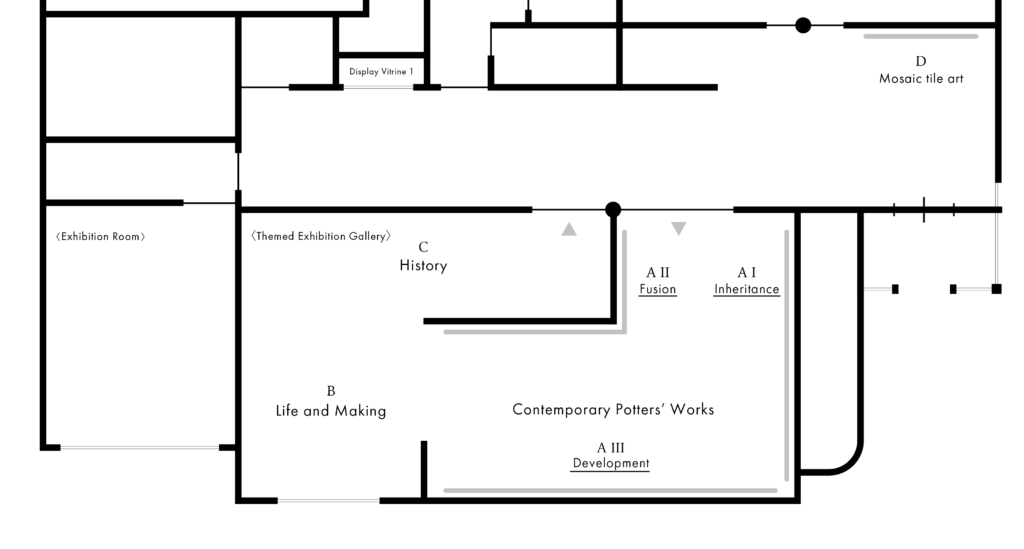
Theme Exhibition Room – Venue Map
INDEX
A Ⅰ.
Inheritance
A Ⅱ.
Fusion
A Ⅲ.
Development
B.
Life and the Making of Pottery
C.
TAMBA Co-Temporary
D.
The Living Spiral Tile Art
A Ⅰ
Contemporary Potters’ Works Area
Inheritance
Tamba ware has carried its traditions forward, transforming its form in response to changing eras and societies. Yet, at the same time, there is something that has remained unchanged for centuries: the act of “facing the kiln and firing.” It is as though, at the center of an unceasing spiral motion, there runs a single line that continues straight from past to future without wavering.
Anagama kilns marked the beginning of Tamba ware in the medieval period. Climbing kilns, introduced in the early modern period, brought about a flourishing of production. Later, in the postwar era, gas, oil-fired, and electric kilns expanded the scope of human control. Even so, what happens within the kiln can never be fully predicted.
To knead the clay while turning over countless thoughts, to shape a form with the utmost care and devotion, and in the end to entrust it to the fire—such is the nature of this work. The surprise, joy, or at times frustration that comes after the kiln has done its work may well be what gives ceramics their profound depth. Tachikui, in particular, did not pursue large-scale industrialization, but continued its handcraft-based ceramic production. Here, standing between human intention and nature, potters pursue their own modes of expression. We invite you to witness the “power of inheritance” that resides within them.
Audio Guide 2
Inheritance
Kilns and Firing
Once shaped, clay is hardened by fire into a durable vessel. In the process, components contained in glazes, clay bodies, and ash, depending on the temperature within the kiln, produce the flow of flame, and the amount of oxygen, colors and textures that are at times unexpected. The moment when a transformation arises that surpasses the maker’s imagination—this is something that continues to captivate the maker.
Today, Tamba ware potters select from multiple firing methods—wood-fired kilns (Anagama and Climbing Kilns), gas kilns, oil-fired kilns, and electric kilns—choosing according to their own philosophy or what best suits each individual work. The same is true of glazing techniques: there is unglazed yakishime ware; pieces that make use of natural ash glaze, formed as ash falls and adheres during firing; and works by employing artificial glazes, in which the potter personally blends ash and minerals.
Whatever the method, within the act of “facing the kiln and firing,” the maker continues to wait for a moment that exceeds imagination. That heart, akin to a wish, will no doubt remain unchanged into the future.
Works List
| No. | Artist | Title | Year | Size |
|---|---|---|---|---|
| AⅠ-1 | TANKYU-GAMA Kunihiko Onishi | Natural Ash Glage Vase | 2019 | H 17 × W 18.5 × D 18.5 cm |
| AⅠ-2 | SHINSUI-GAMA Shinsui Ichino | Gourd-Shaped Water Jar | n.d. | Dimensions unknown |
| AⅠ-3 | CHIYOICHI-TOBO Chiyoichi Shimizu | Akadobeyouhen Rackou Vase | 2020 | H 35 × W 22.5 × D 22.5 cm |
| AⅠ-4 | SHINSUI-GAMA Shinsui Ichino | Natural Ash Glaze Jar | n.d. | Dimensions unknown |
| AⅠ-5 | KEISEN-GAMA Keisen Kitamura | Tamba Ido Tea Bowl | n.d. | Dimensions unknown |
| AⅠ-6 | TANSAI Toru Imanishi | Boat-Shaped Sake Bottle | 2010 | H 19.2 × W 15 × D 15 cm |
| AⅠ-7 | TOKO-GAMA Koushou Ichino | Faceted Natural Ash Glaze Flower Vase | 2000 | H 35 × W 10 × D 10 cm |
| AⅠ-8 | TANSEI-GAMA Seiichi Onishi | Shiro-Tamba Kiln-Transformed Round Serving Plate | n.d. | Dimensions unknown |
| AⅠ-9 | TANSEI-GAMA Seiichi Onishi | Akadobe Kiln-Transformed Tamba Shallot-Shaped Large Sake Bottle | n.d. | Dimensions unknown |
| AⅠ-10 | TANSEN-GAMA Kiyoharu Ichino | Kilm-Fired Flower Vase | 2010 | H 22 × W 55 × D 15 cm |
| AⅠ-11 | TANMAN-GAMA Yasuyuki Morimoto | Faceted Convex Oval Unglazed Flower Vase | 2021 | H 11.5 × W 13.5 × D 12.2 cm |
| AⅠ-12 | TANMAN-GAMA Yasuyuki Morimoto | Faceted Square Unglazed Flower Vase | 2021 | H 15.3 × W 9 × D 9 cm |
| AⅠ-13 | SHOZO-GAMA Genwa Ichino | Water Jar “Gaku” | n.d. | Dimensions unknown |
| AⅠ-14 | MARUSE-GAMA Masaji Ogami | Natural Glaze Dish | 2010 | H 7 × W 46.5 × D 46.5 cm |
| AⅠ-15 | YUMEKOUBOU Isomatsu Ogami | Deformed Jar with Linear Pattern | n.d. | Dimensions unknown |
| AⅠ-16 | NOBORIGAMA Kazuya Shimizu | Tanba Henko | 2015 | H 13 × W 17.5 × D 20.5 cm |
| AⅠ-17 | NOBORIGAMA Kazuya Shimizu | Tanba Hangetsukaki | 2015 | H 27.5 × W 13.8 × D 16 cm |
| AⅠ-18 | TAMBAYAMAKI-GAMA Yoshihito Ogami | Faceted Unglazed Sake Bottle | 2010 | H 47 × W 18 × D 18 cm |
| AⅠ-19 | HONOHOTANKYU-GAMA Toyokazu Shimizu | Incense Burner | 1995 | H 9.5 × W 11 × D 11 cm |
| AⅠ-20 | TOHO-GAMA Tadayoshi Shimizu | Kiln-Transformed Celadon Bottle | 1989 | H 32 × W 13.5 × D 11.5 cm |
| AⅠ-21 | TANZAN-GAMA Yoshihiro Morimoto | Incised Line Pattern | 2020 | H 17 × W 18 × D 18 cm |
| AⅠ-22 | ICHINO DENICHI-GAMA Tatsuya Ichino | Orchid Pot | n.d. | Dimensions unknown |
| AⅠ-23 | CHATOMARUKA-GAMA Toshihiko Ichino | Large Gold Kiln-Transformed Plate | 2015 | H 7 × W 35 × D 35 cm |
| AⅠ-24 | GENUEMON-GAMA Koji Ichino | Flower Vace | c.2005 | H 36 × W 24 × D 24 cm |
| AⅠ-25 | SHOYO-GAMA Yuki Ogami | Ancient Iron Glaze Square Flower Vase | n.d. | Dimensions unknown |
| AⅠ-26 | MIYANOKITA-GAMA Masahiko Imanishi | Tamba Chrysanthemum Motif Three-Handled Jar | n.d. | Dimensions unknown |
| AⅠ-27 | TOSHIHIKO-GAMA Takeshi Shimizu | Kiln-Beaten Pattern Tea Bowl | n.d. | Dimensions unknown |
| AⅠ-28 | MARUHACHI-GAMA Yoshihisa Shimizu | Kiln-Transformed Tamba Guinomi | 2024 | H 5.4 × W 6.5 × D 6.5 cm |
| AⅠ-29 | MARUHACHI-GAMA Yoshihisa Shimizu | Large Kiln-Transformed Tamba Sake Bottle | 2025 | H 22 × W 11.5 × D 10 cm |
| AⅠ-30 | YAMAGOTOUKATSU-GAMA Katsuki Ichino | Image of Clay | n.d. | Dimensions unknown |
| AⅠ-31 | SHOZO-GAMA Shusaku Ichino | Ash Glaze Flower Vase | n.d. | Dimensions unknown |
| AⅠ-32 | INAEMON-GAMA Tsuyoshi Uenaka | Kiln-Transformed Flower Vase | n.d. | Dimensions unknown |
| AⅠ-33 | COCOCHIYA Koh Ichino | Kiln-Transformed Ash Glaze Flower Vase | n.d. | Dimensions unknown |
| AⅠ-34 | CHIYOICHI-TOBO Masatoshi Shimizu | Oribe Vase | 2020 | H 24 × W 26.5 × D 26.5 cm |
| AⅠ-35 | TOSHIHIKO-GAMA Takeshi Shimizu | Salt Kiln Water Jar | n.d. | Dimensions unknown |
| AⅠ-36 | TOKO-GAMA Shota Ichino | Faceted Natural Ash Glaze Flower Vase | 2000 | H 35 × W 10 × D 10 cm |
| AⅠ-37 | TOKO-GAMA Shota Ichino | Faceted Natural Ash Glaze Flower Vase | 2000 | H 35 × W 10 × D 10 cm |
| AⅠ-38 | TOKO-GAMA Shota Ichino | Faceted Natural Ash Glaze Flower Vase | 2000 | H 35 × W 10 × D 10 cm |
| AⅠ-39 | TOKO-GAMA Shota Ichino | Faceted Natural Ash Glaze Flower Vase | 2000 | H 35 × W 10 × D 10 cm |
| AⅠ-40 | ICHINO DENICHI-GAMA Hiromichi Ichino | Morning Glory Bowl / Anagama Kiln | n.d. | Dimensions unknown |
| AⅠ-41 | HONOHOTANKYU-GAMA Tatsuya Shimizu | Beaten Ash Glaze Single-Flower Vase | n.d. | Dimensions unknown |
| AⅠ-42 | HONOHOTANKYU-GAMA Tatsuya Shimizu | Beaten Ash Glaze Single-Flower Vase | n.d. | Dimensions unknown |
| AⅠ-43 | SHINSUI-GAMA Takanobu Ichino | Glass Long Plate | n.d. | Dimensions unknown |
| AⅠ-44 | GAHO-GAMA Kenta Ichino | Colored Ash Glaze Flower Vase | n.d. | H 22 × W 39 × D 33 cm |
| AⅠ-45 | SHINRIN-GAMA Nobuhito Nakaoka | Iridescent Flower Vase | n.d. | Dimensions unknown |
A Ⅱ
Contemporary Potters’ Works Area
Fusion
In current academic research, Tamba ware is understood to have begun in the late Heian Period under the influence of Tokoname ware and other kilns of the Tokai region. At the same time, in the realm of oral tradition, there remains a legend that in the early Heian Period a Hagi potter named Furoyabu Sōtarō brought ceramic techniques to this area. Setting aside the question of historical veracity, what these accounts suggest is that Tamba ware has continually evolved through a kind of chemical reaction between internal development and stimuli from the outside.
“Akadobe,” produced in the early Edo Period and still highly prized today, is said to have emerged with the introduction of the Climbing Kiln and under influences from Bizen and other centers. “Shiro-Tamba,” which appeared in the late Edo Period, arose from admiration for painted porcelains such as Arita ware and Kyo ware, which were enjoying great popularity at the time.
While deeply rooted in this small village, the potters also maintained indirect connections with the outside world. Balancing what was given to them with what they absorbed from beyond, the people of this region have sustained the fires of ceramic production for some 850 years. Here, such “fusion” is expressed through works made with clay from Tamba as well as from other production areas.
Audio Guide 3
Fusion
Fusion / Seven Transformations
In the world of antiques and fine art, a saying has long been passed down: “If you don’t know what it is, call it Tamba.” This reflects the remarkable diversity of Tamba ware—rustic, unglazed utilitarian vessels; tricky, highly technical forms; and pieces adorned with splendid painted decoration. There is a freedom and a certain chaos that seem to resist any simple definition of what “Tamba ware” is. Today, this protean quality is sometimes described as “Tamba’s Seven Transformations.” Behind it lies the flexibility of Tamba’s potters, who have eagerly embraced “new things” flowing in from the outside world with abundant curiosity.
Inheriting the lineage of earlier practitioners, we present works by contemporary potters who have embraced outside influences and opened new horizons of expression.
These include encounters between the traditional Japanese technique of tsutsugaki (slip-trailed decoration) and slipware developed in Britain; the fusion of ceramics with zōgan (inlay), said to have originated in the ancient Orient and reached Japan via the Silk Road; and the adaptation of kiriko cutwork, originally a glasscraft technique, into clay.
We invite you to experience the expanding possibilities of “fusion” that emerge when disparate elements come together.
Animal Ergonomics ×
Ergonomics is the discipline of designing tools, furniture, and environments so people can use them naturally—without strain on the body. In recent years, that way of thinking has been extended to animals as well, sparking new efforts to raise their quality of life.
For example, this pet food bowl by Tadashi Matsumoto of MATSU-GAMA was designed to make eating easier for dogs and cats. Its tall, stemmed form helps food pass more smoothly through the esophagus than bowls placed low on the floor. The color choice matters, too: yellow is widely considered the easiest for dogs and cats to recognize. Wheel-thrown one by one, its gentle presence becomes part of the scenery of a home.
Slipware ×
Tsutsugaki, a technique that flourished in Tamba during the Edo period, involves drawing patterns on the clay surface using slip. A closely related technique is slipware.
While slipware has existed in various parts of the world since ancient times, its rich diversity of expression came into full bloom after the medieval period, alongside the development of ceramic techniques in Britain.
Slipware later faded as mass-produced goods spread, but it was rediscovered through Japan’s Mingei (folk craft) movement, led by figures such as Muneyoshi Yanagi and Shōji Hamada. The British potter Bernard Leach—close to Yanagi and his circle—took up slipware himself and introduced its techniques to ceramic regions across Japan.
TANSO-GAMA was among the workshops shaped by that influence. An exchange with the Leach Pottery in England, begun in the era of the 6th-generation Tanso, was carried forward by the 7th-generation Shigeyoshi and the 8th-generation Shigeko—continuing to share a worldview where the craft beauty of Tamba and Britain interweave.
Zōgan (Inlay) ×
Zōgan (inlay) is a technique in which materials such as metal, ceramics, or wood are inlaid with other materials to create decorative patterns. It is said to have originated in the ancient Orient and to have reached Japan during the Nara period via the Silk Road.
Potters Tetsuji Ichino of ICHINO SATORU-GAMA and Yuki Ogami of SHOYO-GAMA are two artisans who have embraced the art of Zogan in their ceramics. Ichino carves freehand grooves into the surface of his jars, filling the revealed geometric patterns with his own unique blends of colored clay. The lines, finished with a white slip, bring an organic rhythm to each piece, vividly evoking the diverse cultural beauty that Zogan has encountered on its long journey.
On the other hand, Ogami fuses Zogan with the traditional Tamba technique of Shinogi (carving). He creates a new realm of formal possibilities by partially embedding the carved clay fragments back into the surface, applying a white slip for firing, and then adding black pigment afterward. While both artisans share the common foundation of Zogan, they have cultivated two entirely distinct creative worlds.
Kiriko (Cut Glass) ×
“Kiriko” is Japan’s distinctive cut-glass tradition, where patterns are revealed by grinding the surface with polishing tools. Famous examples include Edo Kiriko from Tokyo and Satsuma Kiriko from Kagoshima, both of which began to flourish in the late Edo period.
A different kind of luster—more earthen, more shadowed—appears in the works of Hiroaki Ichino of HIGASHIYAMA-KOBO. In pursuit of pottery that could “sparkle as light scatters,” he experimented until his forms unexpectedly echoed kiriko. By carving fine facets into the shaped clay, then glazing and firing, he draws out a refined, luminous expression.
Kakiotoshi (Sgraffito) ×
Kakiotoshi is a technique in which a layer of slip is applied to the clay body and then scraped away along a design, letting the pattern emerge. Sometimes two layers of slip are used, creating striking depth and color contrast in the carved motif. The method is seen often in ceramics from China’s Northern Song dynasty; in Japan, “Nezumi Shino” ware fired in Mino during the Momoyama period is a well-known example.
Today, Haruna Nishihata of SUEHARU-GAMA and Nobuyuki Ichino of ICHINO NOBUYUKI-GAMA both incorporate kakiotoshi into their work. Using the same technique, each arrives at a completely different world—because color choices and motifs carry the maker’s individual sensibility.
Shinogi ×
That the beauty of Tamba ware was “discovered” by Mingei masters such as Muneyoshi Yanagi, Kanjiro Kawai, and Shōji Hamada—from prewar through postwar years—set a new current in motion: many folk-craft makers began visiting Tamba, bringing fresh air to the village. In 1959, Kazutaka Ikuta, trained under Kanjiro Kawai in Kyoto, moved here and built a kiln. Toshihiko Shimizu of TOSHIHIKO-GAMA became Ikuta’s very first apprentice.
Toshihiko Shimizu, who trained under Kazutaka Ikuta for thirteen years, inherited among other things the technique of shinogi—carving evenly spaced grooves to raise ridgelines. Though shinogi can be seen on late-Edo “kasa-tokkuri” (umbrella flasks), Ikuta drew inspiration from Southeast Asian antiques and, together with Shimizu, re-examined the technique. From that meeting of lineages, a new style of everyday ware emerged.
Works List
| No. | Artist | Title | Year | Size |
|---|---|---|---|---|
| AⅡ-1 | Raw Earth Painting | 2026 | Dimensions variable | |
| AⅡ-2 | Dig the soil, mix it, and shape it | 2026 | Dimensions unknown | |
| AⅡ-3 | SHOYO-GAMA Yuki Ogami | Tamba Ware, Chatter Marks Inlay Sake Bottle | n.d. | Dimensions unknown |
| AⅡ-4 | ICHINO SATORU-GAMA Tetsuji Ichino | Colored Linear Inlay Flower Vase | 2021 | H 32 × W 15 × D 15 cm |
| AⅡ-5 | HIGASHIYAMA-KOBO Hiroaki Ichino | Kiriko Vase | 2026 | H 14.5 × W 14.5 × D 14.5 cm |
| AⅡ-6 | HIGASHIYAMA-KOBO Hiroaki Ichino | Kiriko Plate | 2025 | H 10 × W 32.4 × D 32.4 cm |
| AⅡ-7 | TANSO-GAMA Shigeko Ichino | Bud Vase | 2025 | Dimensions unknown |
| AⅡ-8 | TANSO-GAMA Shigeko Ichino | Slipware | 2025 | Dimensions unknown |
| AⅡ-9 | TOSHIHIKO-GAMA Toshihiko Shimizu | Rice Husk Ash Glaze Chatter-Marked Large Jar | n.d. | Dimensions unknown |
| AⅡ-10 | ICHINO NOBUYUKI-GAMA Nobuyuki Ichino | Geometric Sgraffito Plate | n.d. | Dimensions unknown |
| AⅡ-11 | SUEHARU-GAMA Haruna Nishihata | Floral and Octopus Motif Jar | n.d. | Dimensions unknown |
| AⅡ-12 | SUEHARU-GAMA Haruna Nishihata | Goldfish Motif Rectangular Plate | n.d. | Dimensions unknown |
| AⅡ-13 | MARUMATSU-GAMA Tadashi Matsumoto | Pet Food Bowl | 2025 | H 24 × W 15 × D 10 cm |
A Ⅲ
Contemporary Potters’ Works Area
Development
The old wares of Tamba continue to captivate collectors to this day. Among the most representative are Akadobe, Shiro-Tamba, and Kuro-Tamba.
Akadobe refers to vessels coated with slip to prevent leakage, which, through firing, develop beautiful hues ranging from red to brown.
Shiro-Tamba, made using white slip, achieves a smooth, cream-colored surface reminiscent of porcelain.
Kuro-Tamba is characterized by its lustrous finish, typified by a dark glaze derived from manganese-rich stone.
Many aspects of these red, white, and black expressions remain shrouded in mystery—whether in their methods of production or in raw materials that are no longer obtainable—making faithful reproduction extremely difficult today. Yet this very difficulty has become a driving force that stirs the spirit of challenge among contemporary potters.
Here we present works by potters who, inspired by these masterpieces of the past, do not merely imitate them but instead seek their own distinctive approaches. In some cases, there are startling and unexpected adaptations of technique. Engaging in dialogue with, and at times competing against, potters of the past, they pursue their creative paths. Within their work lies the distinctive character of this production area: while sharing the common ground of Tamba, each artist’s individual ingenuity stands out with striking clarity.
Audio Guide 4
Development
Red
“Akadobe,” a symbol of early-modern Tamba ware, emerged with the introduction of the climbing kiln. Its singular red beauty captivates. Yet Akadobe was produced only for a brief span in the early Edo period before vanishing—leaving unanswered questions: why did it disappear, and how exactly did potters achieve that red? The mystery remains.
Chasing this enigmatic red, contemporary potters propose many approaches: some use red pigments; some employ “shinsha” (cinnabar) glazes; and some attempt to revive older techniques, such as recreating a Heian-period practice of applying urushi lacquer to ceramic surfaces. These works trace many routes toward a red that history left unresolved.
Works List
| No. | Artist | Title | Year | Size |
|---|---|---|---|---|
| A Ⅲ-1 | TANBUN-GAMA Masafumi Onishi | Red Tamba Flower Vase | 2025 | H 20.7 × W 22.6 × D 22.6 cm |
| A Ⅲ-2 | TANBUN-GAMA Masafumi Onishi | Red Tamba Tea Bowl | 2025 | H 10 × W 13.3 × D 13.2 cm |
| A Ⅲ-3 | CHIYOICHI-TOBO Chiyoichi Shimizu | Akadobe Vase | 2020 | H 24.5 × W 19.5 × D 19.5 cm |
| A Ⅲ-4 | GAHO-GAMA Kenta Ichino | Colored Katakuchi Pitcher | n.d. | H 10 × W 14.5 × D 11.5 cm |
| A Ⅲ-5 | GAHO-GAMA Kenta Ichino | Colored Guinomi | n.d. | H 6.5 × W 8 × D 7 cm |
| A Ⅲ-6 | TANKYO-GAMA Akiyoshi Shimizu | Hexagonal Flower Vase | 2020 | Dimensions unknown |
| A Ⅲ-7 | ICHINO HIDEKAZU-GAMA Hidekazu Ichino | Red Clay with Partial Glaze Narrow-Neck Flower Vase | n.d. | Dimensions unknown |
| A Ⅲ-8 | SHINRIN-GAMA Nobuhito Nakaoka | Colored Ash Glaze Tea Bowl | n.d. | Dimensions unknown |
| A Ⅲ-9 | CHATOMARUKA-GAMA Toshihiko Ichino | Flambe Glaze Flattened Jar Flower Vase | 2013 | H 17.5 × W 18 × D 14 cm |
| A Ⅲ-10 | ENNEN-GAMA Masahiro Ichino | Ceramic Lacquer Flower Vase | n.d. | Dimensions unknown |
| A Ⅲ-11 | CHIYOICHI-TOBO Masatoshi Shimizu | Tamba Slip-Decorated Flower Vase | n.d. | Dimensions unknown |
White
“Shiro-Tamba,” created in the late Edo period amid a longing for porcelain, offers a graceful elegance unlike earlier Tamba ware. A warm white is born when white slip—made from white clay—is applied to the body and fired. With Shiro-Tamba’s arrival, painted vessels popular in Arita ware and Kyo ware also began to be produced in Tamba.
Where that white clay was once sourced in Tamba is no longer clear. Today, potters pursue their own whites using other white clays and glazes. Please enjoy the many variations—each maker’s white.
Works List
| No. | Artist | Title | Year | Size |
|---|---|---|---|---|
| A Ⅲ-12 | TOHO-GAMA Tadayoshi Shimizu | White Porcelain Bottle | 1985 | H 22 × W 16 × D 16 cm |
| A Ⅲ-13 | KAMAMOTO YAMANO Koji Ogami | Jar with Ash Glaze | 2017 | H 37 × W 31 × D 31 cm |
| A Ⅲ-14 | NAOSAKU-GAMA Naosaku Shogen | White Glaze Kanjikuchi Bottle | n.d. | H 22 × W 15.2 × D 15.2 cm |
| A Ⅲ-15 | NAOSAKU-GAMA Naosaku Shogen | Shiro-Tamba Tea Bowl | n.d. | H 9 × W 14 × D 14 cm |
| A Ⅲ-16 | OKUMA-GAMA Megumi Ogami | Floral Chatter-Marked Plate | n.d. | Dimensions unknown |
| A Ⅲ-17 | OKUMA-GAMA Megumi Ogami | Chatter-Marked Flower Vase | n.d. | Dimensions unknown |
| A Ⅲ-18 | KANETO-GAMA Keiichi Shimizu | Tamba Vase | 2025 | H 10.5 × W 17.5 × D 13 cm |
| A Ⅲ-19 | ICHINO HIDEKAZU-GAMA Hidekazu Ichino | Stone-Shaped Flower Vase | n.d. | Dimensions unknown |
| A Ⅲ-20 | KAMAMOTO YAMANO Masayuki Ogami | Kasanaru Shinogi | n.d. | Dimensions unknown |
| A Ⅲ-21 | TANSEN-GAMA Chisato Ichino | Vase | 2020 | H 15.5 × W 14 × D 14 cm |
| A Ⅲ-22 | YAMAGOTOUKATSU-GAMA Katsuki Ichino | Tanka Bowl | 2025 | H 6.5 × W 21 × D 19.5 cm |
| A Ⅲ-23 | SHOZO-GAMA Mayuko Ichino | Flower Small Bowl | 2020 | H 5 × W 10 × D 10 cm |
| A Ⅲ-24 | SHOZO-GAMA Mayuko Ichino | Flower Plate | 2025 | H 2 × W 15 × D 15 cm |
| A Ⅲ-25 | TASAURA Ken Hata | Untitled | n.d. | H 8.2 × W 6.5 × D 6.5 cm |
| A Ⅲ-26 | TASAURA Ken Hata | Untitled | n.d. | H 12 × W 7.5 × D 7.5 cm |
| A Ⅲ-27 | TASAURA Ken Hata | Untitled | n.d. | H 5.8 × W 6.7 × D 6.7 cm |
| A Ⅲ-28 | TASAURA Ken Hata | Untitled | n.d. | H 7 × W 7.8 × D 7.8 cm |
| A Ⅲ-29 | TANSUI-GAMA Satoru Tanaka | Kohiki 30 cm Rim Plate | 2026 | H 2.5 × W 32 × D 32 cm |
| A Ⅲ-30 | TANSUI-GAMA Satoru Tanaka | Cracked Slip Flattened Jar | 2024 | H 29 × W 20 × D 8 cm |
| A Ⅲ-31 | SUEHARU-GAMA Tadashi Nishihata | Snow Landscape Vessel | 2026 | H 70 × W 33 × D 30 cm |
| A Ⅲ-32 | COCOCHIYA Masatoshi Ichino | Indigo Flower Vase | n.d. | Dimensions unknown |
Black
A deep, lustrous black—evoking Tamba’s famed black soybeans. Classic examples used “Ishiguro” glaze, made by crushing black stone rich in manganese. As reproducing Ishiguro glaze has grown difficult, today’s potters continue to experiment: blending their own iron glazes, coating vessels in black slip before firing, or challenging “carbonization firing,” where oxygen is cut off during firing.
From glossy black to matte black, each black carries its own voice.
Works List
| No. | Artist | Title | Year | Size |
|---|---|---|---|---|
| A Ⅲ-33 | GOUJIN-GAMA Goujin Nomura | Black Smoked Kiln-Transformed Jar | n.d. | Dimensions unknown |
| A Ⅲ-34 | GOUJIN-GAMA Goujin Nomura | Black Smoked Faceted Guinomi / Gold-Decorated Black Kakashi Cup | n.d. | Dimensions unknown |
| A Ⅲ-35 | SHINRIN-GAMA Nobuhito Nakano | Hikidashi Black Tea Bowl | n.d. | Dimensions unknown |
| A Ⅲ-36 | TSUBOICHI Genshow Ichino | Faceted Iron Glaze Jar | 2023 | H 25 × W 23 × D 23 cm |
| A Ⅲ-37 | OKUMA-GAMA Takumi Ogami | Three-Legged Pot | n.d. | H 35.5 × W 34.5 × D 34 cm |
| A Ⅲ-38 | SHINSUI-GAMA Shinsui Ichino | Black Glaze Tea Bowl | n.d. | Dimensions unknown |
| A Ⅲ-39 | MARUHACHI-GAMA Kumiko Shimizu | Black-Glazed Vase | 2024 | H 14.3 × W 8.5 × D 8.5 cm |
| A Ⅲ-40 | GOUJIN-GAMA Goujin Nomura | Black Smoked Leaning Tower Flower Vase | n.d. | Dimensions unknown |
| A Ⅲ-41 | MIYANOKITA-GAMA Masahiko Imanishi | Kuro-Tamba Tea Bowl | n.d. | Dimensions unknown |
| A Ⅲ-42 | SHOYO-GAMA Yutaka Ogami | Kuro-Tamba Carved Floral Plate | n.d. | Dimensions unknown |
B
Life and Making Area
Life and the Making of Pottery
Tachikui is a settlement set within a narrow valley, flanked by mountains to the east and west. Even today, as you walk through the village, you can see smoke rising from kilns here and there.
This space reflects scenes from everyday life in the village: the quiet, steady work of potters projected onto walls made from Tamba clay; the tools used in their workshops; and freshly fired vessels still dusted with ash.
Without large-scale industrialization or division of labor, Tamba has sustained a tradition of family-based craftsmanship. We invite you to sense the atmosphere unique to this place.
Audio Guide 5
Life and Making
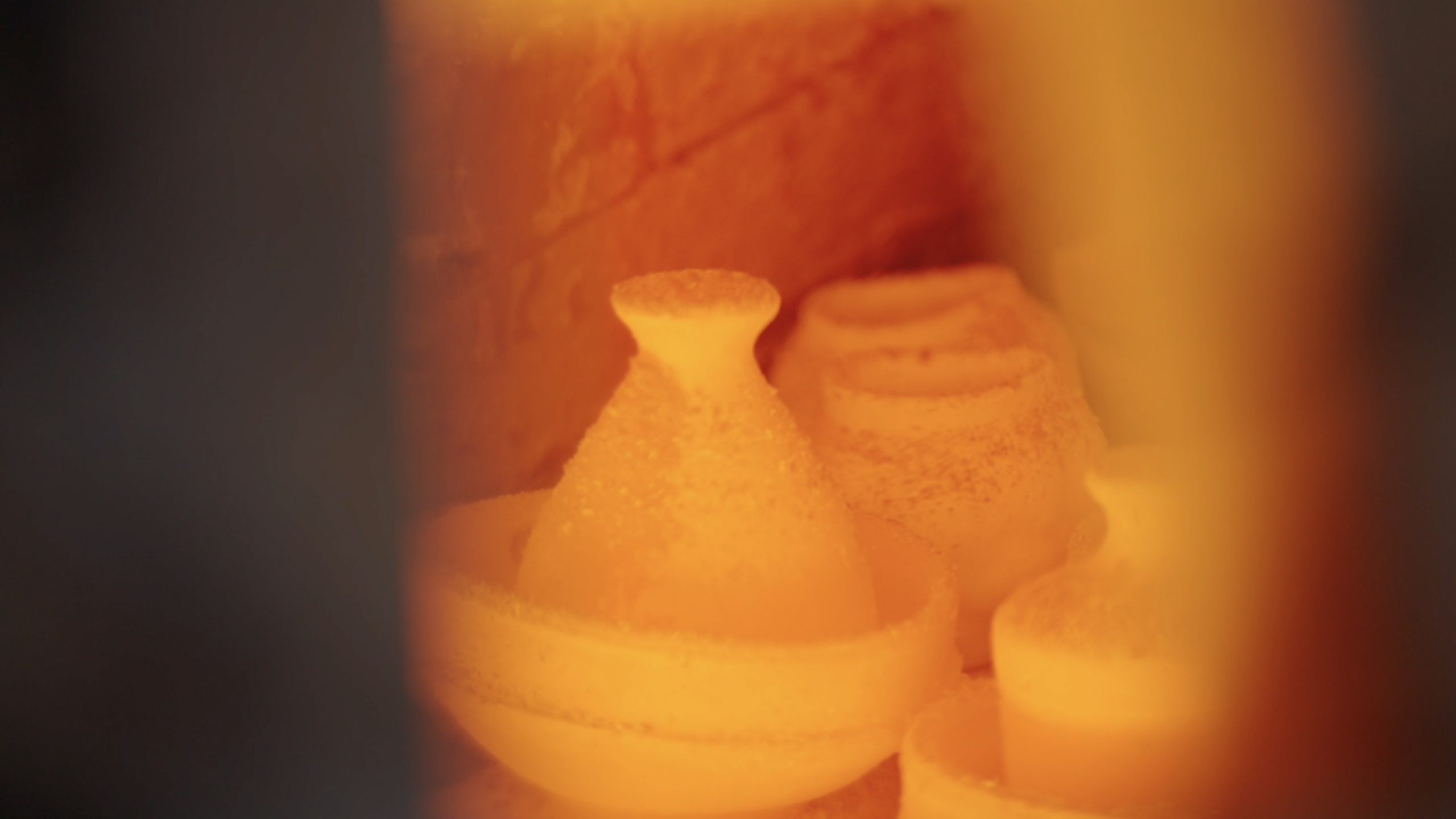
Once the vessels have been shaped and glazed and carefully loaded into the narrow kiln chamber, the potters offer prayers at the household shrine, and a firing that may last for dozens of hours begins. As they confront the flames, probing the changes unfolding within the kiln, we invite you to observe the potters at work.
Filming cooperation: ICHINO DENICHI-GAMA / Hiromichi Ichino, and COCOCHIYA / Koh Ichino
Filmed by Hibiki Miyazawa
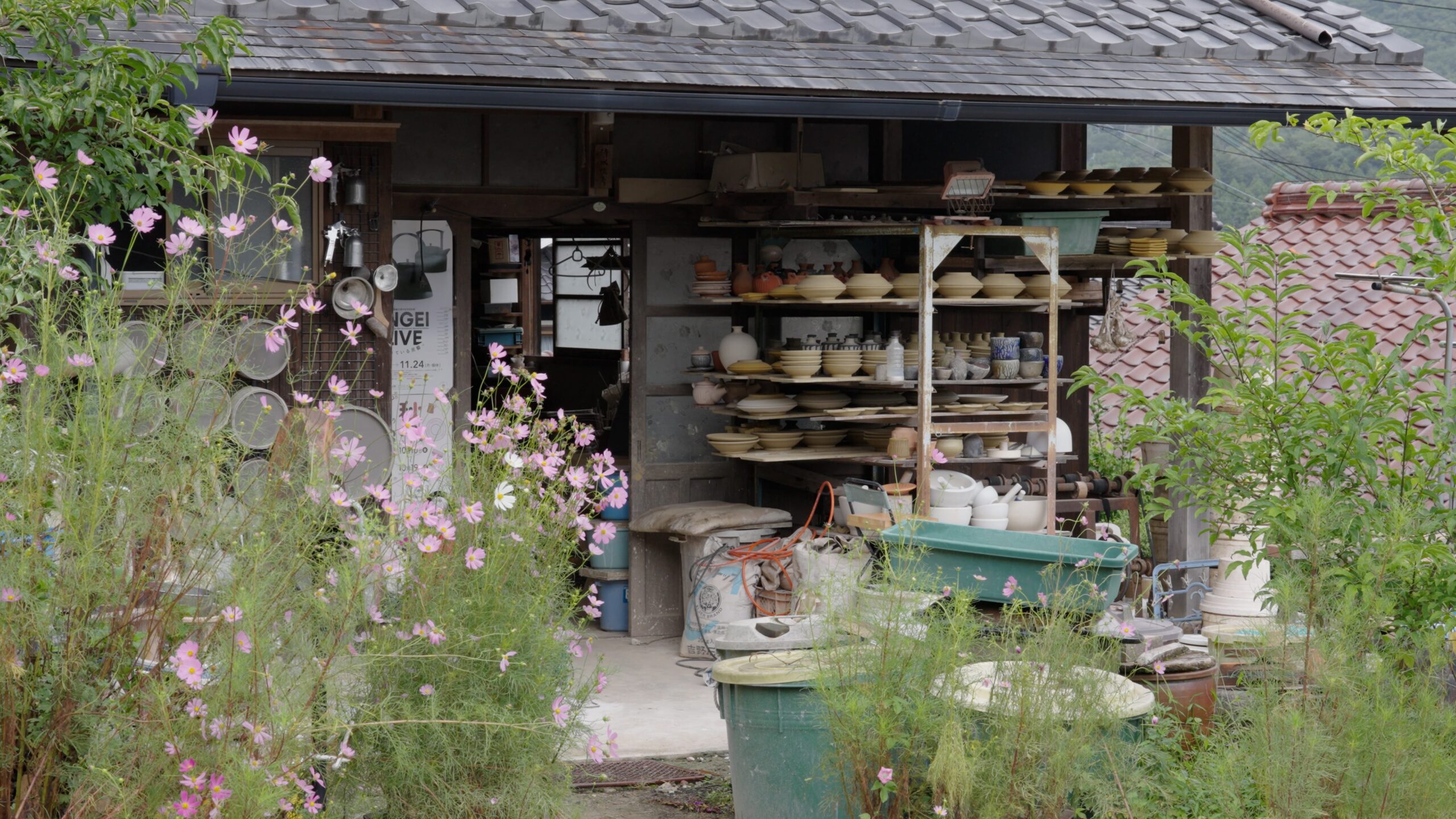
Day after day, potters knead clay, turn the wheel, and add decorative elements to their works. A rhythm ingrained in their bodies gives form, one after another, to what was once merely a lump of earth. Here, making is part of daily life.
Filming cooperation: TOSHIHIKO-GAMA / Toshihiko Shimizu
Filmed by Hibiki Miyazawa
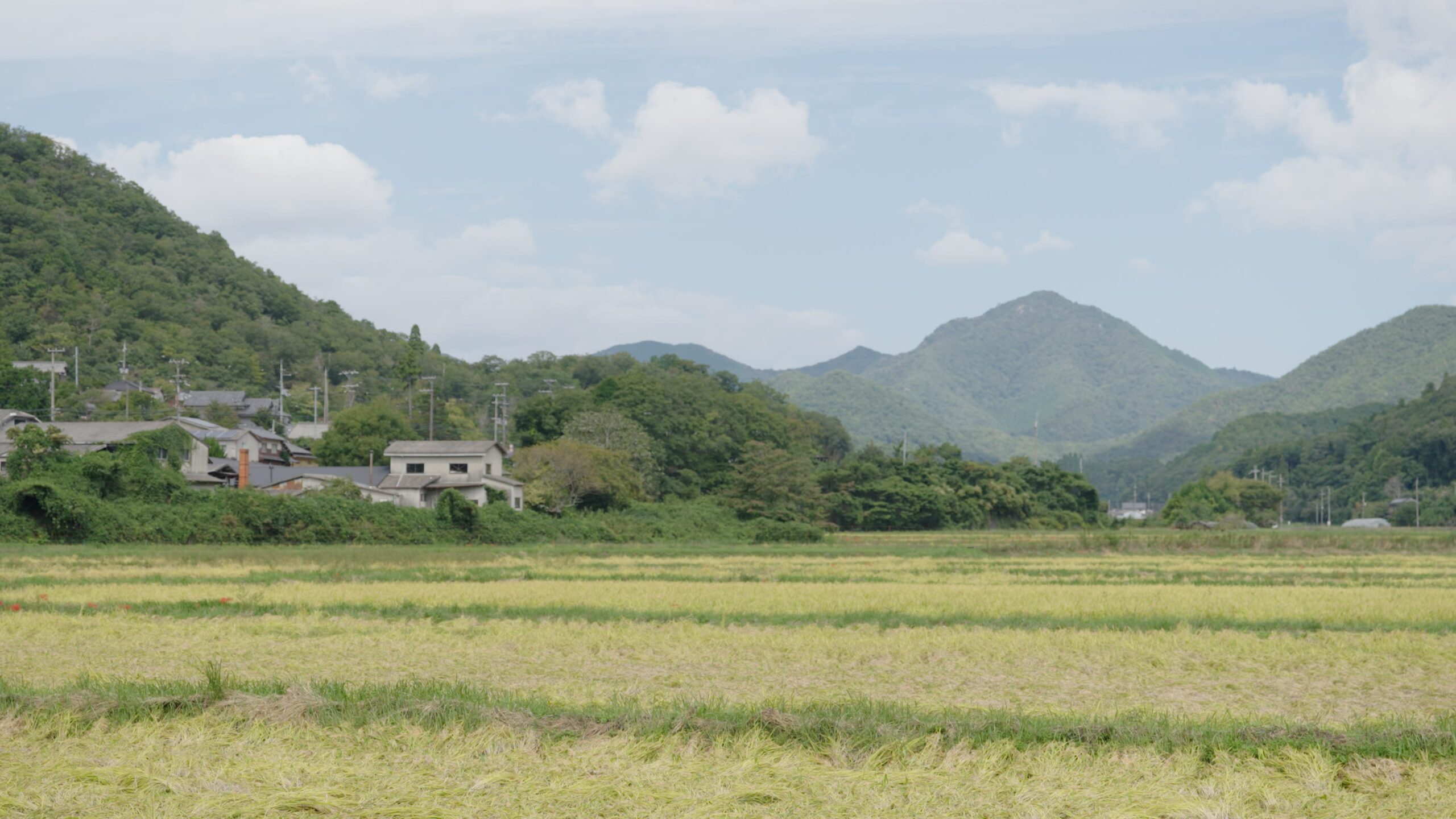
Tachikui is a settlement in a narrow valley between mountains to east and west. The view of Mt. Kokuzo—long associated with Prince Shotoku—fills people’s hearts as it shifts in character with the seasons. This landscape may well be the wellspring of the aesthetic sensibility that has sustained Tamba ware across generations.
Filmed by Hibiki Miyazawa
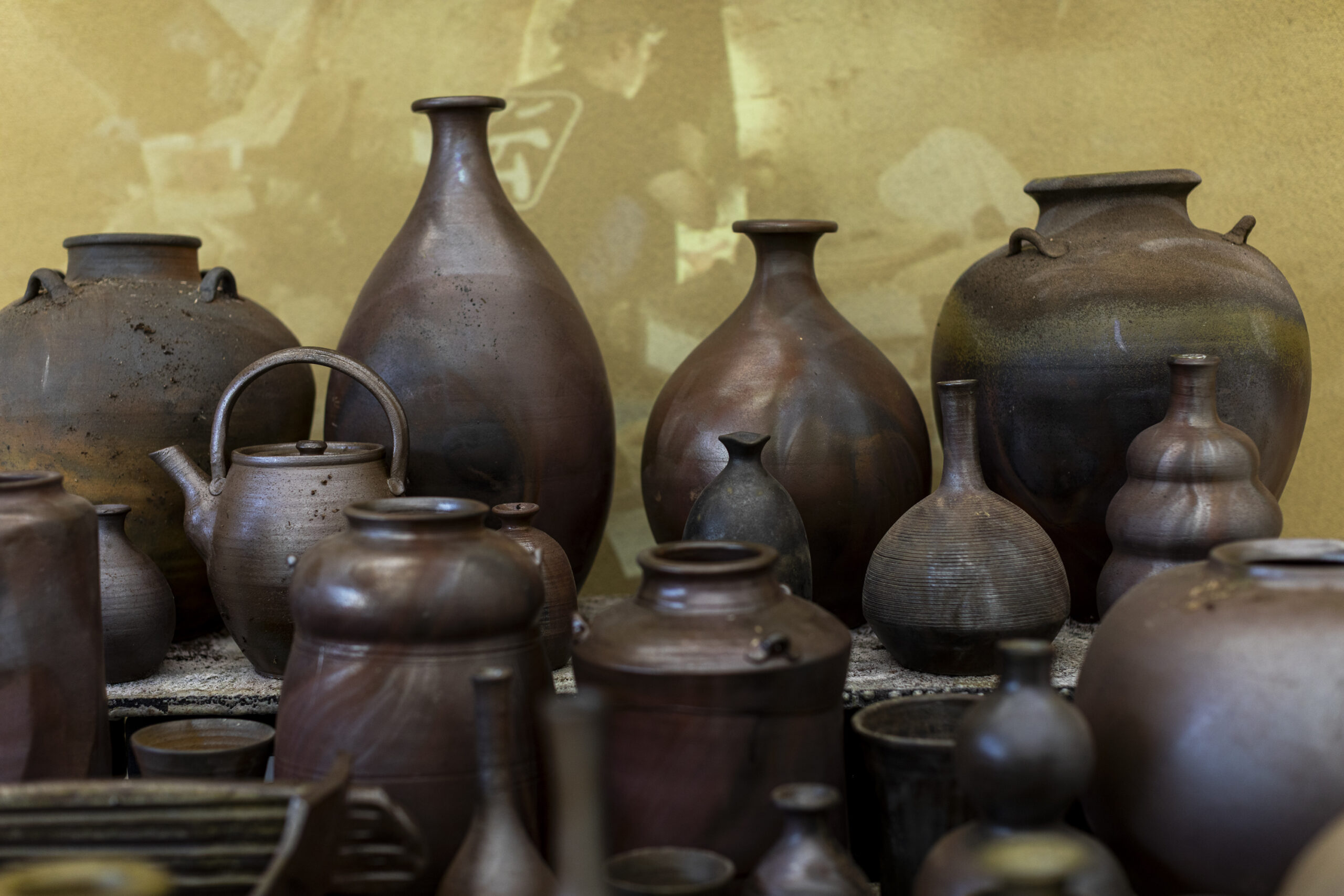
Freshly fired vessels wait to be removed from the kiln. An array of tools reveals the individuality of each potter. Here, a way of life unchanged for centuries endures. We invite you to encounter the presence of potters who engage with earth and fire—forces of nature—through their own physical labor.
Supported by: ICHINO DENICHI-GAMA / Hiromichi Ichino, and COCOCHIYA / Koh Ichino
C
History Area
TAMBA Co-Temporary
Tamba ware began in the mountain valleys of Tamba Province and has continued in an unbroken line for some 850 years. Seen in a broader perspective, it has always formed part of the great currents of a changing Japan and an ever-moving world. The keyword “TAMBA Co-Temporary” arises from this recognition. Although Tachikui was a poor farming village surrounded by mountains, it lay near a strategic point where the borders of the three provinces of Tamba, Settsu, and Harima met. Windows through which outside influences could flow in were everywhere.
Temporary refers to something provisional or of limited duration. Even history, which may appear as vast and enduring as a great river, can be understood as a collection of temporary points rather than something permanent. It is like the Milky Way, formed from the gathering of countless stars. In ceramics, there have been many points of contact where external stimuli and inner will have met. Tamba ware has developed by breathing in these momentary instances of contemporaneity.
Anagama Kilns were constructed at Sanbon-toge, regarded as the birthplace of Tamba ware, and full-scale ceramic production began in the late Heian Period. Shards excavated from sites of that time reveal the influence of Tokai-region wares such as Tokoname.
The split-bamboo-style climbing kiln that appeared in the early Edo Period bears strong influence from the Korean Peninsula. It is thought that this development may have been related to Toyotomi Hideyoshi’s invasions of Korea, which resulted in many Korean potters being brought to Japan.
In the Edo Period as well, when Tamba ware entered a phase of remarkable diversity, one can discern stimuli from other production centers. For example, Kyo ware, which had developed under the influence of the brilliant painted porcelains of Arita, gradually exerted its own influence on Tamba ware.
Here we present an overview of the history of Tamba ware as it evolved under such influences from the outside world. We invite you to reflect on the path of Tamba ware, which has continued to mark countless points of co-temporality across the centuries.
Audio Guide 6
TAMBA Co-Temporary
Sanbon-toge
Regarded as one birthplace of Tamba ware, “Sanbon-toge” lies near the border where Settsu, Harima, and Tamba once met. In the late Heian period, a tunnel-like anagama kiln was built into these mountain slopes. Surveys of the Sanbon-toge North Kiln Site—one of Tamba’s oldest kiln remains—have revealed a kiln about 14 meters long and roughly 2.2 meters wide. In anagama firing, pieces placed close to the flames receive heavy deposits of wood ash. When that ash melts in the heat and turns into a green, glassy layer on the surface, it is called a natural ash glaze (shizen-yū). This is one hallmark of Tamba ware from the anagama era.
A 1977 investigation of the haibara—dump areas where charcoal, ash, and misfired shards accumulate at archaeological sites—turned up fragments such as jars reminiscent of 13th-century Tokoname ware, as well as incised pieces bearing motifs like chrysanthemum patterns. In contrast to those signs of outside influence, the study also revealed a distinctly Tamba approach in suribachi (mortars): rather than using a comb-like tool to make grooves, potters carved lines one by one with a spatula. That method continued for roughly four hundred years, until the Edo period.
Tsutsugaki
From the late Edo period through the Meiji and Taishō eras, Tamba produced many “kayoitokkuri” (returnable sake flasks) used to transport sake and soy sauce. Also known as “binbō-tokkuri” (poor man’s flasks), these containers often bore brand names or shop crests written using the tsutsugaki technique. With a tool made from a bamboo tube—fitted with a fine bamboo tip—thin lines of slip are flowed onto the surface to draw letters and images. The displayed flask was excavated from the Sasayama castle town. Guiding a bamboo tool to write on a curved vessel would have required skill, and even these everyday wares carry the quiet virtuosity of Tamba potters.
Uki-tokkuri (Floating Sake Flask)
Tamba ware has long responded to the wishes of its users. A vivid expression of that character is the “uki-tokkuri” (floating sake flask), made in large numbers from the late Edo period onward. Designed to warm sake and be served directly at the table, it was thinly made—a form seen only in this era. Filled to about seventy percent and set in hot water, the flask floats upright, bobbing gently. Uki-tokkuri were made across Japan, but Tamba ware is said to have circulated in particularly large quantities—perhaps because busy restaurants and inns found them practical for warming many flasks at once. The smooth curve created by the swelling body and narrowed waist rests comfortably in the hand.
Akadobe
“Akadobe” displays a spectrum of reds—from purplish red-brown and deep russet to brilliant scarlet. It is said to have begun with the introduction of the climbing kiln, under influences from centers such as Bizen, and has become an emblem of early-modern Tamba ware. Here, “tobe” refers to slip: the surface is coated to help prevent leakage, then fired. Among Akadobe, pieces that glow with especially vivid scarlet are rare, and are prized as some of the most treasured examples of ancient Tamba ware.
Research continues today. The slip is thought likely to have been iron-rich “Tamba bengara” or possibly mineral scale, yet many details—such as exact firing temperatures—remain uncertain.
Shiro-Tamba
“Shiro-Tamba,” admired for its warm white surface, began to be made in the late Edo period. White slip—made by mixing cedar-ash glaze into white clay—is applied to the body and fired, producing an elegance unlike earlier Tamba ware. Shiro-Tamba is thought to have arisen from a longing for porcelain in a region that could not produce true porcelain. With its emergence, painted vessels popular in Arita ware and Kyo ware also began to be made in Tamba.
Exactly where the white clay was sourced, and how it was fired, is no longer known. That very uncertainty continues to draw today’s potters and lovers of Tamba ware.
Works List
| No. | Excavated artifacts |
|---|---|
| C-1 | Jar Fragment |
| C-2 | Mortar Fragment (Excavated from Sanbontoge South) |
| C-3 | Jar Fragment (Excavated from the Sanbontoge South Kiln Site) |
| C-4 | Makura (Used in the earliest Noborigama) |
| C-5 | Akadobe Jar Fragment (Excavated from the Former Sannomaru Site of Sasayama Castle) |
| C-6 | Uki Sake Bottle (Excavated from the Former Sannomaru Site of Sasayama Castle) |
| C-7 | Shiro-Tamba (Excavated from the Former Sannomaru Site of Sasayama Castle) |
| C-8 | Kayoi Sake Bottle (Excavated from the Former Sannomaru Site of Sasayama Castle) |
D
TAMBA GATEWAY CENTER ENTRANCE
The Living Spiral Tile Art
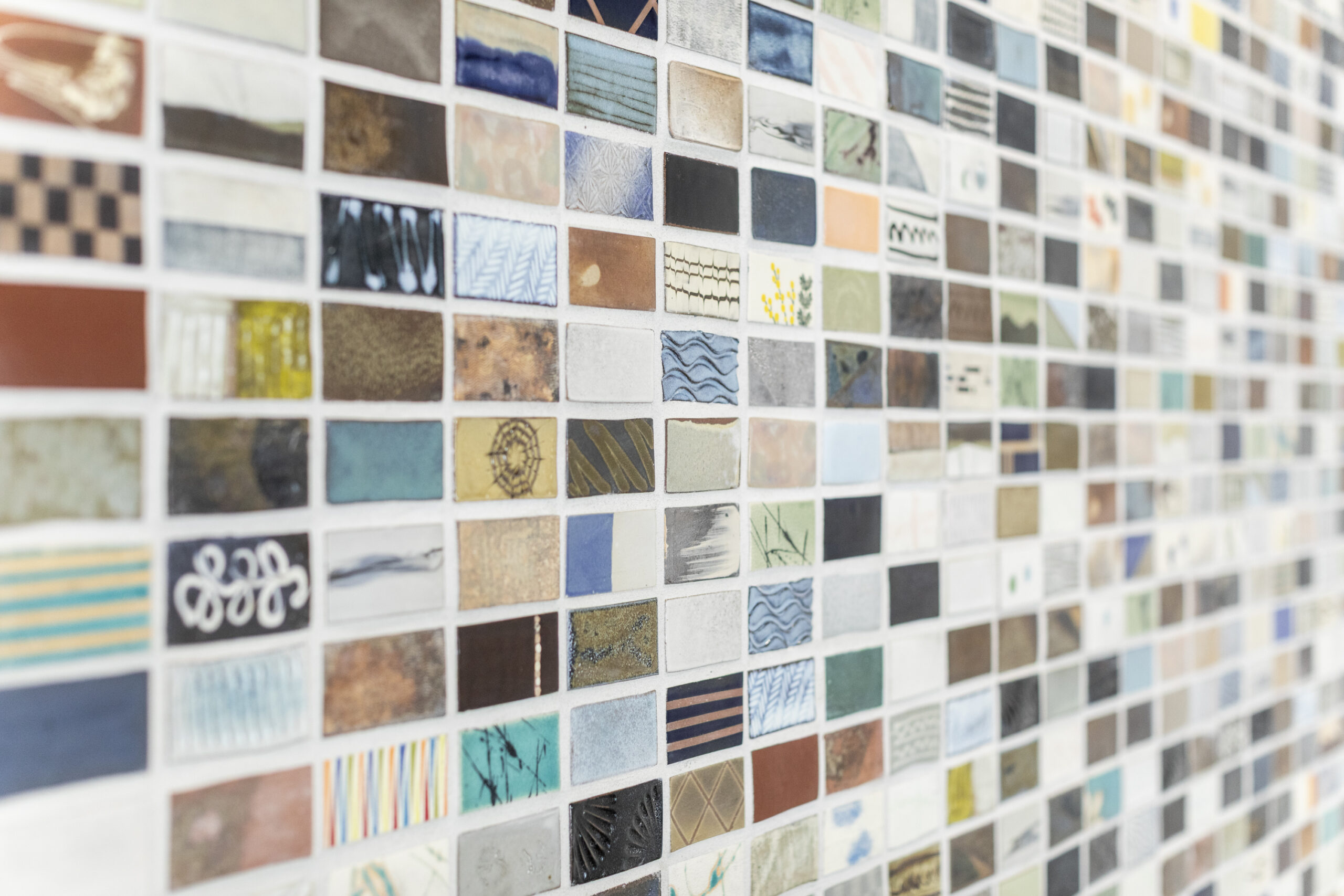
A mosaic of ceramic tiles—now a symbol of the center—spreads across the entrance wall. To create the 1,000 tiles, more than 60 potters from 50 kilns took part. Each tile is different: in glaze, in decorative technique, in firing method. Within the same fixed size, every piece speaks clearly of its maker’s hand and voice.
In Tamba, each maker walks their own path—independent, unwavering—while inspiring one another as fellow inheritors of the same history. See how these many voices, distinct and uncompromising, come together side by side and settle into a quiet, beautiful harmony.
Organized by
Tamba-Sasayama City; The Tamba Tachikui Pottery Cooperative
Produced by
mitemo
In cooperation with
Hyogo Ceramic Museum
Digital Archive
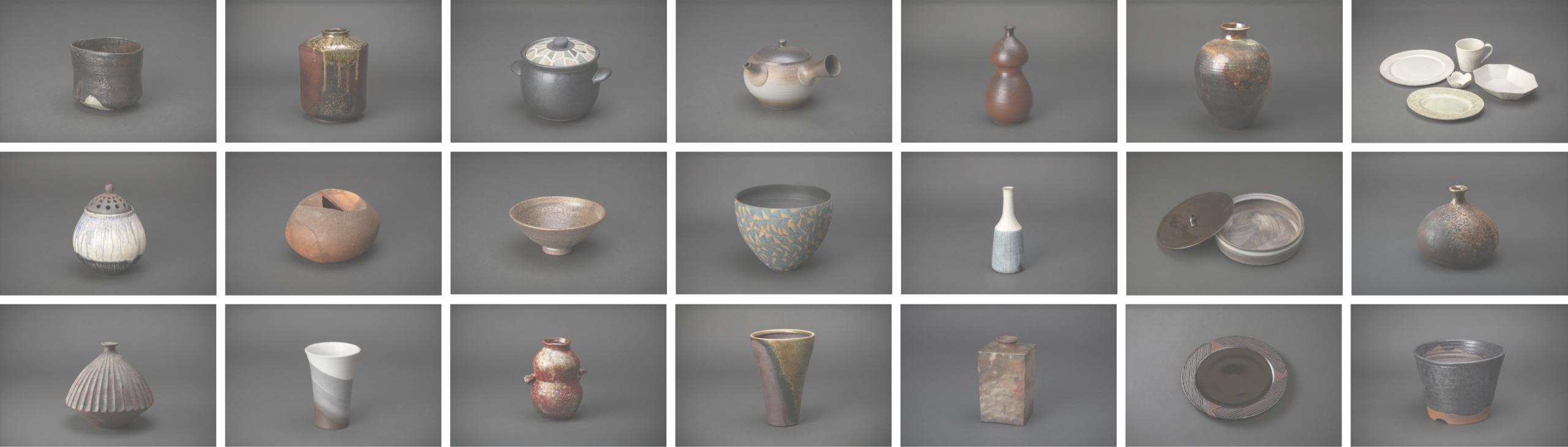
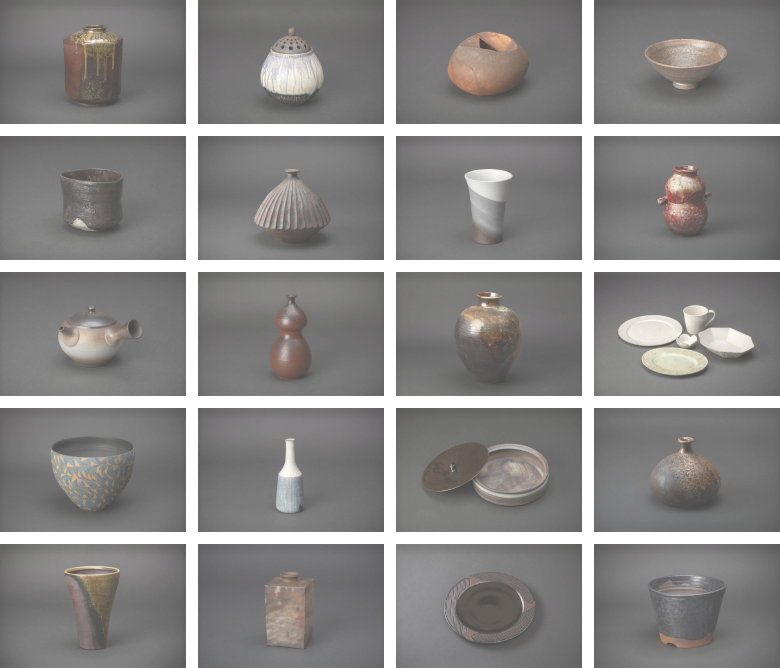
This archive offers another perspective from which to experience the appeal of Tamba ware beyond the exhibition itself. We invite you to take your time exploring the diverse expressions created by
contemporary ceramic artists.
See more